
🖼️ Local AI Image Generator
An easy, zero-setup local image and text AI studio for Windows, Linux, and macOS.
Text Chat
The Text Chat workspace runs official llama.cpp binaries and keeps language models separate from image models:
- Image models:
app/models - Text GGUF models:
app/llm-models - Portable llama.cpp binaries:
app/llm-backend/<platform>
The normal platform setup installs both image and text backends. Text and image engines are mutually exclusive by default to avoid exhausting shared RAM or VRAM. A small Qwen2.5 Coder starter model is available from the Text Chat download panel.
| Generation Workspace | Model Library | Image Constraints |
|---|---|---|
 |
 |
 |
🎥 Watch the Setup & Demo Video: https://youtu.be/ESELhY-G_9w
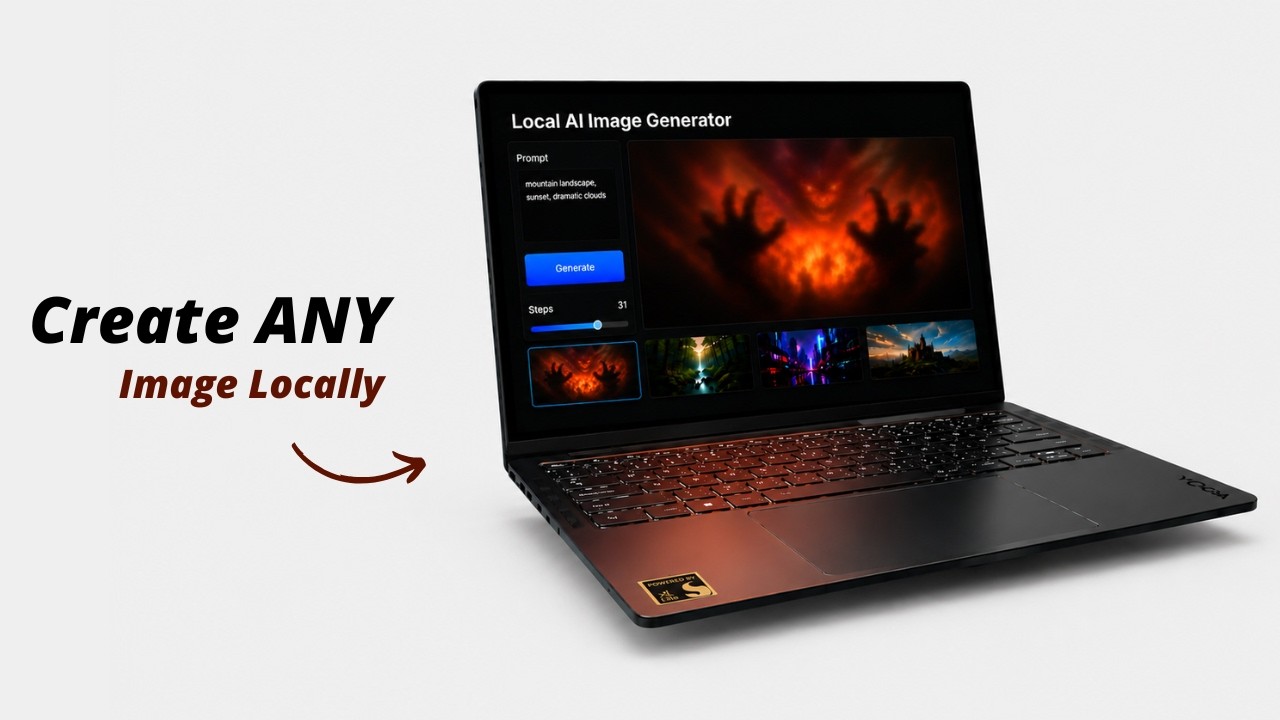
📖 Overview
Local AI Image Generator is a zero-configuration, portable desktop environment for running Stable Diffusion (Safetensors/GGUF/CKPT) offline on Windows, Linux, and macOS. Running windows.bat (Windows), ./linux.sh (Linux), or ./mac.sh (macOS) automatically handles dependency setup, GPU backend matching, and launches a high-performance local web workspace.
⚡ Quick Start
Windows
- Launch: Double-click
windows.bat(downloads portable Node.js and pre-compiled GPU backend binaries on first run). - Add Models: Drop
.safetensors,.gguf, or.ckptweights intoapp/models/(or download them via the Model Manager tab in the UI). - Generate: Open
http://localhost:1420in your browser, select your model, and write a prompt.
Linux
- Check compatibility: Prebuilt Linux backends are built on Ubuntu 24.04 and require glibc 2.38+. Run
ldd --versionto verify. - Launch: Open a terminal in the project folder and run
./linux.sh(downloads portable Node.js and pre-compiled GPU backend binaries on first run).- NVIDIA GPU users will be prompted if they want to set up the high-performance CUDA backend (which attempts to download a prebuilt binary first and automatically compiles from source as a fallback if conflicts are found).
- For maximum AMD GPU performance, use
./linux.sh --max-perfon first setup (adds the ROCm backend). - For Intel Core Ultra NPU support, install the Intel Linux NPU driver, then run
./linux.sh --setup-openvino.
- Add Models: Drop
.safetensors,.gguf, or.ckptweights intoapp/models/(or download them via the Model Manager tab in the UI). - Generate: Open
http://localhost:1420in your browser, select your model, and write a prompt.
macOS
- Check compatibility: The prebuilt macOS backend is for Apple Silicon (M1 or newer) and uses Metal GPU acceleration. (Note: macOS Intel hardware is completely unsupported and has not been tested.)
- Launch: Open Terminal in the project folder and run
./mac.sh(downloads portable Node.js and the pre-compiled Metal backend on first run). - Add Models: Drop
.safetensors,.gguf, or.ckptweights intoapp/models/(or download them via the Model Manager tab in the UI). - Generate: Open
http://localhost:1420in your browser, select your model, and write a prompt.
✨ Features
- 100% Offline & Private: Inference runs completely locally on your hardware.
- Auto-Detected GPU Acceleration: Configures CUDA for Nvidia cards, ROCm for AMD cards, Vulkan for AMD/Intel/NVIDIA fallback, and Metal for Apple Silicon Macs.
- Zero System Footprint: Node.js is sandboxed inside the folder. No global environment paths are altered.
- Integrated Model Manager: Paste a Hugging Face URL to download weights directly, or drag-and-drop local weight files to import them.
- Real-time Telemetry: Monitor RAM, VRAM, CPU, and GPU load directly in the UI.
- Local Gallery: Saves generated PNGs alongside prompt metadata JSONs to
app/outputs/.
📁 Repository Structure
local-ai-image-generator/
├── windows.bat                # Main double-click entrypoint (Windows)
├── linux.sh                   # Main terminal entrypoint (Linux)
├── mac.sh                     # Main terminal entrypoint (macOS)
├── PLAN.md                    # Linux port implementation plan
├── LICENSE                    # MIT Open Source license
├── .gitignore
├── README.md
├── scripts/
│   ├── setup.ps1              # Automated GPU-detect and environment installer (Windows)
│   ├── setup.sh               # Automated GPU-detect and environment installer (Linux/macOS)
│   ├── reset.ps1              # Cleans runtime environments (Windows)
│   ├── reset.sh               # Cleans runtime environments (Linux/macOS)
│   └── serve.cjs              # UI web server and backend lifecycle manager
└── app/
    ├── frontend/              # UI source code (Vite + React)
    ├── models/                # Place weights here (.safetensors, .gguf, .ckpt)
    └── outputs/               # Saved images and parameters metadata
🖥️ GPU Compatibility Matrix
Windows
| GPU Vendor | Tech | Status | Notes |
|---|---|---|---|
| Nvidia | CUDA | ✅ Native | Maps sd-cuda.exe with Nvidia SDK 12 optimizations. |
| AMD Radeon | Vulkan | ✅ Native | Maps sd-vulkan.exe with Vulkan API acceleration. |
| Intel Arc | Vulkan | ✅ Native | Maps sd-vulkan.exe for Intel hardware. |
| Integrated / None | CPU | ⚠️ Fallback | Runs on logical CPU threads (slow). |
Linux
| GPU Vendor | Primary | Fallback | Notes |
|---|---|---|---|
| NVIDIA | CUDA / Vulkan | Vulkan / CPU | Auto-detects NVIDIA. Prompt-driven CUDA setup downloads prebuilt or compiles from source. Falls back to Vulkan for GTX. |
| AMD Radeon | ROCm | Vulkan | ROCm provides best AMD performance when host ROCm drivers are available. |
| Intel Arc / integrated | Vulkan | CPU | Cross-vendor Vulkan support. |
| Intel Core Ultra NPU | OpenVINO NPU | CPU | Requires the Intel Linux NPU driver, kernel 6.6+, Python 3, and ./linux.sh --setup-openvino. |
| Integrated / None | CPU | — | Runs on logical CPU threads (slow). |
macOS
| Hardware | Primary | Fallback | Notes |
|---|---|---|---|
| Apple Silicon (M1 or newer) | Metal | CPU | Uses the official Darwin arm64 stable-diffusion.cpp backend. |
System requirements:
- 64-bit Windows 10 or Windows 11 is required for the portable Node.js 22 runtime used by the Windows launcher.
- glibc 2.38 or newer is required for the prebuilt Linux backends (Ubuntu 24.04, Fedora 40+, etc.).
- The setup script will warn you if your glibc is older. You can still run setup, but the prebuilt backends will not start.
- Linux OpenVINO NPU: Intel Core Ultra, x86_64 Linux, kernel 6.6+, a working
/dev/accel/accel0device, Python 3 withvenv, and the Intel Linux NPU driver are required. - Apple Silicon (M1 or newer) is required for the prebuilt macOS Metal backend. (Note: macOS Intel hardware is completely unsupported and has not been tested.)
Linux setup modes:
- Default (
./linux.sh): Downloads CPU + Vulkan backends (~120–150 MB). If an NVIDIA GPU is detected, prompts to set up CUDA (attempts to download prebuilt, otherwise compiles from source). - Maximum Performance (
./linux.sh --max-perf): Also downloads the ROCm backend. Total download ~1.3 GB. - Intel NPU (
./linux.sh --setup-openvino): Creates a local OpenVINO Python environment and verifies that the Intel NPU driver exposes anNPUdevice.
⏱️ Performance Benchmarks
Typical generation times for an image with 20 steps (e.g. 512x512 resolution; actual times can vary depending on specific hardware specifications, clock speeds, and system load):
| Operating System | Backend / Hardware | Typical Time (512x512) | Notes |
|---|---|---|---|
| Windows | NVIDIA RTX (CUDA) | ~10 seconds | Native CUDA with Tensor Core acceleration. |
| Windows | AMD Radeon / Intel Arc (Vulkan) | ~89 seconds | Cross-vendor Vulkan GPU fallback. |
| Windows | NVIDIA GTX (Vulkan) | ~30 seconds | Vulkan is faster than CUDA on legacy GTX cards. |
| Windows | CPU | 150 - 300+ seconds | Legacy fallback, highly dependent on CPU cores. |
| Linux | NVIDIA RTX (CUDA) | ~10 seconds | Automated source-build / prebuilt CUDA. |
| Linux | AMD Radeon (ROCm) | ~15 - 30 seconds | Native AMD performance (requires ROCm drivers). |
| Linux | NVIDIA GTX (Vulkan) | ~29 seconds | Tested on GTX 1650 (25.5s sampling, 3.7s decode). |
| Linux | AMD / Intel Arc (Vulkan) | ~89 seconds | Vulkan API acceleration. |
| Linux | Intel Core Ultra (OpenVINO NPU) | ~15 - 40 seconds | Dedicated Intel NPU hardware acceleration. |
| Linux | CPU | 150 - 300+ seconds | Logical thread computation. |
| macOS | Apple Silicon M-Series (Metal GPU) | ~12 - 25 seconds | Native Metal backend on Apple Silicon. |
| macOS | Apple Silicon ANE (Apple NPU) | ~10 - 18 seconds | CoreML compilation on Apple Neural Engine. |
🛠️ Troubleshooting
- Reset Environment: If a build fails or you want to clear dependencies, run
scripts/reset.ps1(Windows) orscripts/reset.sh(Linux/macOS). (This preserves your models and generated images). - Port Conflicts: The frontend uses
1420by default. The backend tries8080first, then automatically falls back to a free port if8080is already busy. - Linux backends fail to start with
GLIBC_2.38' not found: The prebuilt binaries require glibc 2.38+ (Ubuntu 24.04). Upgrade your distribution or build stable-diffusion.cpp from source (see below). - Linux ROCm not loading: Make sure your AMD GPU and kernel are compatible with ROCm 7.13. The app will automatically fall back to Vulkan if ROCm cannot initialize.
- Windows exits with code
3221225781: This is0xC0000135, which means Windows could not load a required backend DLL. For AMD/Intel Vulkan, update the GPU driver with Vulkan support, then rerun setup soapp/backend/win/vulkan/is repaired. For NVIDIA CUDA, update the NVIDIA driver and rerun setup so CUDA runtime DLLs are restored. - Generation shows "server is not responding or crashed": The backend process exited. Check the terminal where you ran
./linux.shor./mac.shfor the exact error (common causes are glibc mismatch, missing Vulkan drivers, or out-of-memory).
🔨 Building Linux Backends From Source
The setup script (scripts/setup.sh) now automates building and setting up the CUDA backend from source when selected. If you want to manually build all backends (CPU, Vulkan, and CUDA) at once, you can run the included scripts/build_from_source.sh script.
For macOS, the included scripts/build_from_source.sh builds the Metal backend and copies it to app/backend/mac/sd.
Requirements
git,cmake,make(orninja), and a C++17 compiler (g++/clang++).- For CUDA: the NVIDIA CUDA toolkit (
nvcc) must be on yourPATH. - For Vulkan: the Vulkan SDK / loader and a compatible driver.
- For ROCm: AMD ROCm development libraries.
- For macOS Metal: Apple Command Line Tools or Xcode.
Build commands
# 1. Clone upstream
git clone https://github.com/leejet/stable-diffusion.cpp.git
cd stable-diffusion.cpp
mkdir build && cd build

# 2. Configure for your backend (pick ONE)
# CPU only
cmake .. -DSD_BUILD_SHARED_LIBS=ON -DCMAKE_BUILD_TYPE=Release

# CUDA
cmake .. -DSD_CUDA=ON -DSD_BUILD_SHARED_LIBS=ON -DCMAKE_BUILD_TYPE=Release

# Vulkan
cmake .. -DSD_VULKAN=ON -DSD_BUILD_SHARED_LIBS=ON -DCMAKE_BUILD_TYPE=Release

# ROCm
cmake .. -DSD_HIPBLAS=ON -DSD_BUILD_SHARED_LIBS=ON -DCMAKE_BUILD_TYPE=Release

# macOS Metal
cmake .. -DSD_METAL=ON -DSD_BUILD_SHARED_LIBS=ON -DCMAKE_BUILD_TYPE=Release

# 3. Build
cmake --build . --config Release -j$(getconf _NPROCESSORS_ONLN 2>/dev/null || sysctl -n hw.ncpu)

# 4. Copy the binaries into this project
cp bin/sd* /path/to/Local-AI-Image-Generator/app/backend/linux/<backend>/
After copying, rename the server binary to match what scripts/serve.cjs expects:
- CPU:
sd→sd-cpu - Vulkan:
sd→sd-vulkan - ROCm:
sd→sd-rocm
Then restart the app with ./linux.sh (Linux) or ./mac.sh (macOS).
📝 License
This project is licensed under the MIT License - see the LICENSE file. Bundles stable-diffusion.cpp (MIT License). Model weights are subject to their respective creators' licenses.